

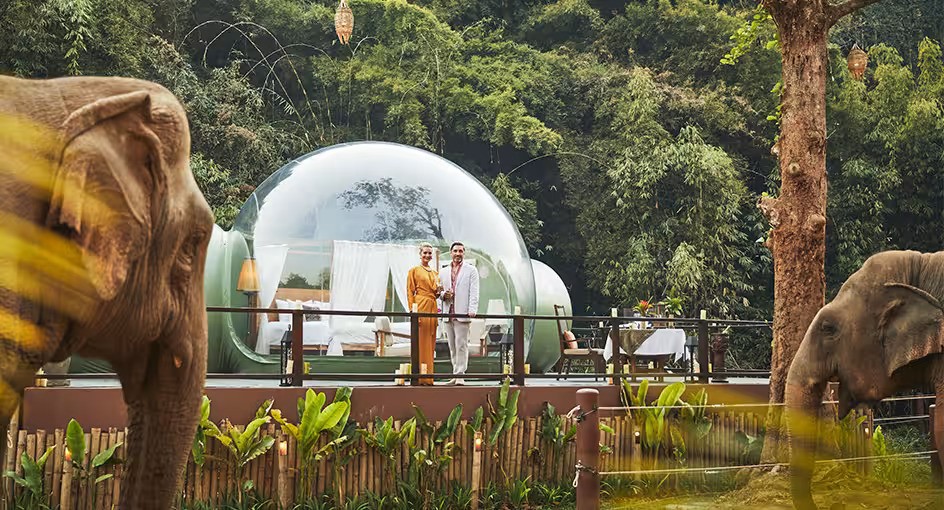
Thailand has long been celebrated for the breadth and inventiveness of its hospitality offering, but few concepts have captured the imagination of modern travellers quite like the bubble hotel. Transparent, spherical, and designed to dissolve the boundary between the interior and the natural world beyond, these extraordinary structures have redefined what it means to spend a night in the Thai wilderness. For those asking what are the most unique bubble hotels in Thailand where you can sleep under the stars, the answer spans misty northern highlands, dense jungle canopies, and dramatic hillside terrain that offers some of the most arresting night skies in Southeast Asia. Sleeping inside a bubble hotel is not merely a novelty — it is an experience that asks you to reconsider your relationship with the landscape around you. Before you book, however, it is worth understanding exactly what awaits.
1. The Accommodation Itself: Transparency, Space, and Design
A bubble hotel room is, at its most fundamental, a transparent inflatable or rigid-shell structure that allows guests to look directly out into the surrounding environment from within the comfort of a private, climate-controlled space. In Thailand, these structures range from modestly sized sleeping pods to generously appointed suites complete with king-sized beds, en-suite bathrooms, and curated furnishings that befit a luxury stay. The transparent walls are typically made from high-clarity polycarbonate or reinforced PVC, engineered to provide clear, undistorted views in all directions. By day, the bubble frames the landscape like a living painting; by night, the ceiling becomes a window onto an unobstructed sky. Interiors are designed with an understanding that the view is the statement — décor tends toward the understated, ensuring nothing competes with the natural spectacle beyond the walls.
- Structures made from high-clarity polycarbonate or reinforced PVC for undistorted views
- Interiors range from intimate sleeping pods to fully appointed luxury suites
- Climate-controlled environments maintain comfort regardless of outdoor temperature
- Minimalist interior design deliberately yields the visual focus to the surrounding landscape
2. Location and Setting: Where Thailand’s Bubble Hotels Are Found
The setting of a bubble hotel is inseparable from its appeal, and Thailand’s northern highlands in particular have emerged as the natural home of this accommodation concept. The landscapes of Chiang Rai, Chiang Mai, and the Golden Triangle region offer the combination of dramatic elevation, low light pollution, and rich biodiversity that make a transparent room genuinely compelling. Properties such as Anantara Golden Triangle Elephant Camp & Resort have integrated bubble accommodation into settings of extraordinary natural and cultural significance, placing guests at the confluence of Thailand, Laos, and Myanmar with jungle and river vistas that are genuinely unlike anything found elsewhere in the region. Bubble hotels in southern Thailand and island settings are less common, though the concept is gradually extending beyond the north as demand grows.
- Northern Thailand — Chiang Rai, Chiang Mai, and the Golden Triangle — is the primary hub
- Anantara Golden Triangle places bubble guests at the meeting point of three countries
- Jungle, hillside, and riverside settings are the most common natural contexts
- Low light pollution in highland areas makes night sky viewing particularly rewarding
3. Privacy and the Transparency Question
The most common concern raised by first-time bubble hotel guests is also the most understandable: if the walls are transparent, what happens to privacy? Reputable properties have addressed this thoughtfully. Most bubble hotels in Thailand position their structures with deliberate separation between units, ensuring that sightlines between neighbouring bubbles are minimal or non-existent. Many operators also provide blackout curtains or automated tinting systems that can be activated at the guest’s discretion, particularly useful for those who find themselves waking earlier than intended as daylight fills the space. The experience of sleeping in full view of the natural world is, for many guests, unexpectedly liberating — but it benefits from choosing a property that has considered the privacy question with genuine care rather than as an afterthought.
- Bubble units are positioned with deliberate spacing to minimise sightlines between guests
- Blackout curtains or automated tinting systems available in most quality properties
- Orientation of each unit is carefully considered during the design and placement process
- Guests are encouraged to visit the property’s layout map before arrival to understand positioning
4. Climate, Comfort, and What the Seasons Mean for Your Stay
Thailand’s climate varies considerably by region and season, and this has a meaningful bearing on the bubble hotel experience. In the northern highlands, the cool season between November and February offers the clearest skies, the most comfortable temperatures, and the lowest humidity — conditions that are widely regarded as ideal for transparent accommodation. The hot season from March to May can make the greenhouse effect of a fully transparent structure a consideration, though well-engineered bubbles with effective air conditioning manage this reliably. The rainy season, while less commonly considered, can offer its own dramatic appeal — watching a tropical storm from inside a sealed, climate-controlled bubble is an experience with its own particular intensity. Guests should research the seasonal profile of their chosen property carefully before selecting travel dates.
- Cool season (November to February) offers optimal conditions: clear skies and low humidity
- Quality bubble structures use reinforced air conditioning to manage heat in warmer months
- The rainy season stays offer a dramatically different but equally memorable experience
- Northern highland elevations are significantly cooler than Bangkok and coastal Thailand
5. What to Expect from Service, Dining, and the Wider Experience
A bubble hotel stay is rarely a standalone accommodation experience — it is typically embedded within a broader resort or retreat offering that shapes the quality of the visit as much as the bubble itself. At the upper end of the market, guests can expect full resort amenities: spa facilities, guided jungle treks, cultural experiences, and dining that draws on the richness of northern Thai cuisine. Breakfast delivered to the bubble at first light, with mist rolling across the valley below, is a ritual that many guests cite as the defining memory of their stay. It is worth noting that the more remote the property, the more self-contained the experience tends to be — which is, for most guests, precisely the point. Mobile connectivity may be limited in highland settings, and this, too, is something the majority of bubble hotel guests come to regard not as an inconvenience but as an unexpected gift.
- In-bubble breakfast at sunrise is a signature experience offered by leading properties
- Wider resort amenities typically include spa services, guided treks, and cultural excursions
- Remote highland locations naturally limit connectivity, encouraging a genuine digital detox
- Northern Thai cuisine — fragrant, herb-driven, and distinct from central Thai cooking — is a highlight
Important Tips Before You Book a Bubble Hotel in Thailand
A bubble hotel stay rewards those who arrive prepared. Keep the following in mind before and during your visit to ensure the experience meets expectations.
- Book well in advance — bubble units are typically limited in number and sell out quickly, particularly during the cool season.
- Pack layers for northern Thailand nights; highland temperatures can drop considerably after sunset, even in warmer months.
- Confirm the blackout curtain or tinting system before arrival if you are a light-sensitive sleeper — sunrise arrives early and brightly inside a transparent room.
- Choose a property with on-site dining or room service; the remoteness of most bubble hotels makes leaving for meals impractical and, frankly, counterproductive.
- Avoid properties that position bubble units in proximity to one another without clear privacy measures — spacing and orientation matter significantly.
- Check the structural material: rigid polycarbonate shells offer better insulation and durability than inflatable PVC structures, particularly in variable weather.
- Download any films, music, or reading material before arrival — Wi-Fi in remote highland settings is frequently limited or unavailable.
- Consider travelling as a couple rather than with children for a first visit; the experience is most fully appreciated in its quieter, more contemplative form.
A bubble hotel stay in Thailand is, at its best, one of the most singular experiences available to the modern traveller. It is a rare thing — an accommodation concept that genuinely delivers on its promise, placing you inside the landscape rather than merely beside it. Choose your property carefully, time your visit well, and the night sky above northern Thailand will be something you carry with you long after you return home.